


We all wish we could go back to the good ‘ol days. A time when things were simpler. For most of us, that’s the time when we were kids, or teenagers, or maybe taking our first steps into adulthood.
For those of us born before the internet era, the only way we’ve been able to experience a glimpse back into that time is through old photographs and maybe some low-resolution family videos. But what if we could experience the past as if we were living it now?
A.I. is trying to answer that.
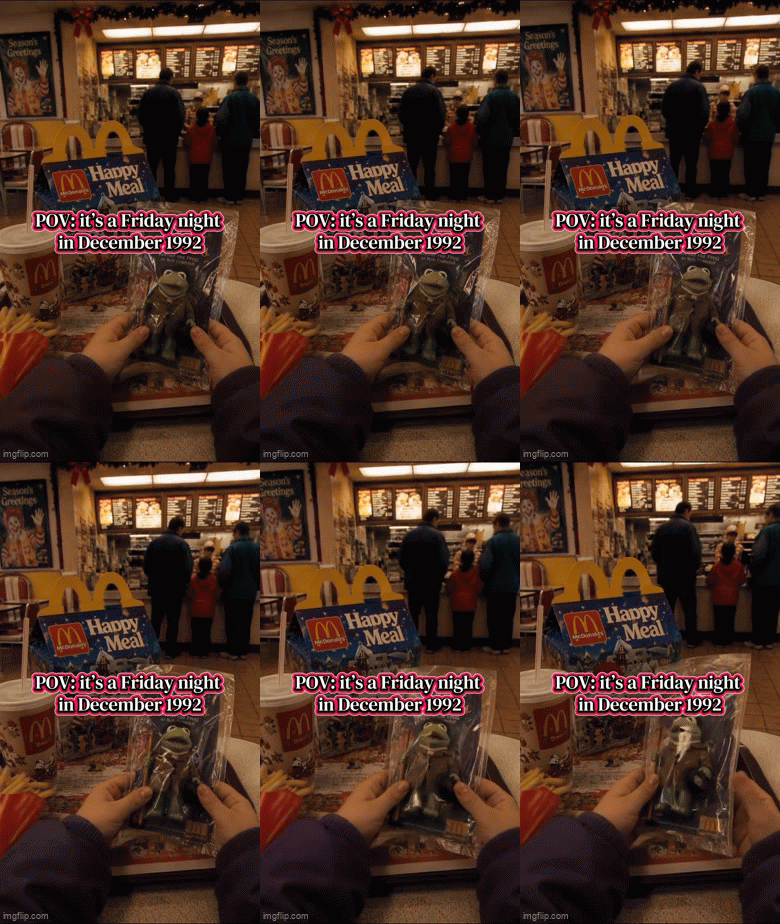
A “POV” of waking up in the 80s. An “AI avatar” sent back to roam a 90s mall. Kids in 2025 receive a tearful video message from their AI-generated younger selves, urging them to put down their phones and go play outside. Prompt-generated nostalgic images are filling feeds in response to the yearning of both older and younger generations for an era that no longer exists.
For the millions of people who consume this content, it’s almost like time traveling. Stepping back into a world that no longer exists.
Here’s the problem, though.
None of it happened. None of these scenes were filmed, lived, or witnessed by anyone. They’re generated on demand from a prompt. This is not even a real place. It’s a plausible-looking guess at one, assembled by a model that has never actually seen 1980 or 1992, only millions of photographs that claim to be from those eras.
We’ve always been nostalgic for eras we know mostly through other people’s photographs — that’s not new. What’s new is that we can now manufacture the photographs themselves, and the gap between remembering something and generating something that looks like a memory is collapsing fast enough that most people scrolling past aren’t stopping to ask which one they’re looking at.
So what happens when we start manufacturing our memories? And how do we preserve the truth of the past when people so easily cling to the idea of a moment instead of its reality?
Nostalgia Has Always Been a Little Bit Fiction
To be fair to the trend, nostalgia was never purely accurate to begin with. The version of the 90s most people are nostalgic for — sun-bleached, analog, free-range, soundtracked by a mixtape — was always a curated slice of a much messier decade. Photographs themselves have always done a kind of editing too: you only take pictures of the good day, the lake trip, the birthday party, not the ordinary Tuesday. Memory was always doing some of this work for free, smoothing edges, keeping the warm parts, and letting the rest fade.
So, in one sense, AI nostalgia content is just doing faster and more aggressively what photography and memory were already doing slowly. It’s not inventing the impulse to romanticize the past. It’s industrializing it.
But there’s a difference between memory rounding off the edges of something that happened and a model generating a scene with no underlying event to round off in the first place. One is a distortion of a true thing. The other is a true-looking thing with nothing underneath it.
An Imagined Past Made Real (Sort Of)
What makes the A.I. nostalgia trend different from, say, an artist creating something from their own memory of the past is its ability to mimic reality while having no actual basis in it.
A.I can generate entire scenes, entire “memories,” of moments that never happened to anyone, populated by people who were never there, often depicting decades the person generating the content never lived through at all.
A 19-year-old generating an AI video of themselves as a kid in 1994 isn’t drawing from a memory they had to relive it. They’re manufacturing a childhood. Not their own — a generic one, built from the visual residue of a thousand other people’s real childhoods, scraped and blended into something that has the texture of memory without being attached to a single actual life.
It’s not just nostalgia for a real past. In many cases, it’s nostalgia for a past that was never anyone’s — a kind of ambient longing for an aesthetic, detached entirely from lived experience, that still elicits a genuine emotional response in the person watching it. The feeling is real. The memory triggering it is not.
The Bigger Problem
This is where it stops being a TikTok curiosity and becomes something anyone who takes images seriously should pay attention to.
For as long as photography has existed, the photograph has carried an implicit claim: I was there, and this is roughly what it looked like. That claim is the entire reason photographs have historically functioned as evidence — in journalism, in court, in family archives, in the box of prints in your parents’ closet that prove, irrefutably, that the events of your childhood took place.
AI-generated nostalgia content doesn’t make that claim and mostly isn’t trying to deceive anyone outright — most viewers know, on some level, that it’s generated. But the visual grammar it borrows is the grammar of evidence. It uses grain, flash overexposure, and period-accurate styling specifically because those signals read as documentation to the human eye.
It’s borrowing the credibility of the photograph without doing what earned it credibility in the first place: someone being there with a camera, capturing life as it is in that moment.
Multiply that by a few more years of model improvement, and the line between “content styled to evoke the past” and “content indistinguishable from a real photograph of the past” gets thinner. People who study photojournalism for a living have been raising versions of this alarm for a while now — warning that once synthetic imagery becomes common and good enough, it doesn’t just create individual fakes; it has the potential to quietly reshape what we collectively believe the past looked like, depending on whose version got generated, and how widely it spread.
The nostalgia trend feels low-stakes because nobody’s claiming the 90s mall video is a real historical document. But it’s training an entire generation’s eye to read AI-generated period imagery as emotionally and visually credible. That’s not nothing. That’s the exact skill a more dangerous use of the same technology would depend on.
Photography as a Protection of the Past
This is the place where the photographer’s role becomes more of a civic one, even when the work itself is personal — a wedding, a family portrait, a quiet afternoon.
A real photograph, taken by a person who was actually present, is a small act of evidence-making. It says: this happened, here, to these people, and I was close enough to see it. No model can manufacture that claim honestly, no matter how convincing the grain or the lighting gets, because the claim isn’t really about the image. It’s about the presence behind it.
That’s worth saying plainly to clients, and worth holding onto as a working photographer in a moment when “looks real” is becoming cheap and “is real” is becoming the actual differentiator. The two used to be the same thing. They aren’t anymore, and the gap between them is where the work’s value now lies.
A few things to consider, practically:
Talk about presence as the product, not just the photos. What you’re actually selling, more than ever, is the fact that you were physically there for something true. That’s worth naming out loud to clients, not assuming they already understand it.
Be plain about your process. If you use AI for culling, editing, or color work — most working photographers do — say so, and say what it touched and what it didn’t. Clarity itself is becoming part of what builds trust, separate from the technical result.
Protect your own archive like it matters, because it does. The unglamorous, half-blurry, badly lit photos sitting on your hard drive are increasingly exactly the kind of unmanufactured evidence that’s becoming rarer and more valuable. Don’t think of your backlog as just raw material. Think of it as a record.
Remember what nostalgia is supposed to cost. Real nostalgia is expensive — it costs you the years it took to get far enough away from something to miss it.
AI-generated nostalgia is free and instant, and that’s exactly what should make you suspicious of it. The feeling it produces is real. The thing it claims to be a memory of is not. Worth knowing the difference, especially if your job is to make the kind of images people will be nostalgic for one day.
Want more deep dives into photography of the future and how to make it as a working artist in a world filled with A.I.? Subscribe to Make Art. Make Money. and get inside tips, tricks, and insights from the top photo editors, agents, and photographers in the business, delivered straight to your inbox.